
OpenClaw, Claude Code & Claude Cowork: A Complete Guide
Why This Shift Actually Matters
For a few years, "AI assistant" meant: you type something, it types back. That era isn't over, but something fundamentally different has emerged alongside it, tools that don't just respond, but act.
Three tools define this new landscape most clearly. OpenClaw is an open-source framework that turns any language model into a persistent, always-on agent running on your own hardware. Claude Code is Anthropic's purpose-built coding assistant that works across entire codebases, not just isolated snippets. Claude Cowork is a desktop agent for knowledge workers that automates file-heavy tasks without requiring any technical skill.
They share a common thread: autonomy. All three can work through multi-step jobs, make decisions along the way, and produce outputs that would have taken hours of manual effort. But they do this in ways that are so different from each other — in scope, security model, cost, and ideal user — that treating them as interchangeable is a mistake.
This guide walks through each tool in depth, compares them side by side, and gives you a straight answer to the question that actually matters: which one do you need?
- 200K+ OpenClaw GitHub Stars
- $285B SaaS Market Cap Shaken by Cowork Launch
- 85% Token Use Reduction in Claude Code (Jan 2026)
The line between AI tool and AI agent is blurring fast. A year ago, Claude was a chatbot. By early 2026, it has a CLI, a sandboxed desktop agent, an ecosystem of curated plugins, and a framework connecting to thousands of external tools.
— Pattern observed across the 2025–2026 AI agent landscape
OpenClaw
Open Source
OpenClaw didn't begin as a finished product, it began as a GitHub project called Clawdbot in November 2025, built by Peter Steinberger, the Austrian engineer behind PSPDFKit. Within weeks it had tens of thousands of stars. After a trademark dispute and a brief detour as "Moltbot," it became OpenClaw. By early 2026, it had over 200,000 stars and a community of contributors growing faster than almost any open-source project in recent memory.
What It Actually Is
OpenClaw is not a chatbot, and it's not a model. It's an orchestration layer — a framework that sits on top of whatever AI model you choose (Claude, GPT-4, DeepSeek, Gemini, or a locally running model) and turns it into an agent with real access to your files, your machine, and your communication channels.
You run it on your own hardware: a Mac Mini, a Linux server, a Windows machine via WSL2, or even a Raspberry Pi. You connect it to the messaging apps you already use — WhatsApp, Telegram, Slack, Discord, iMessage, Signal. Once it's running, you interact with it through those apps, and it takes real action on your host machine in response.
What People Are Actually Using It For
- Clearing 4,000-email backlogs autonomously
- Automated morning briefings via Telegram before 7am
- Car price negotiation — scraped quotes, forwarded PDFs, $4,200 saved
- Full family meal planning systems in Notion
- Building flight search tools via messaging in under 20 minutes
- CRM updates and invoice generation for small teams
- RSS monitoring and task scheduling
- Mass email unsubscribe (500+ emails, no manual work)
Setup and Cost Reality
OpenClaw is free and open-source. The setup takes 30–60 minutes via an onboarding wizard (openclaw onboard) and requires Node.js 22+ and comfort with the command line. The ongoing cost comes from API usage, typically $50–$150/month for moderate use. Aggressive automation can push that past $300 in a single day. Running local models eliminates that cost, but with a quality trade-off.
The Security Reality
This is the part that deserves serious attention. OpenClaw's security is opt-in, not enforced by default. Most users grant it Full Disk Access and Terminal Access because setup guides lead that way. Sandboxing is off by default. Multiple DM sessions share a main session by default, which creates cross-contamination risk.
The community skill marketplace (ClawHub) has had significant issues: Bitdefender found roughly 900 malicious skills — around 17–20% of the total. A Snyk audit found 13% of skills contain critical flaws. AMOS stealer malware was delivered through at least three distinct skills targeting macOS. In January 2026, over 30,000 publicly exposed OpenClaw instances were found leaking API keys, chat histories, and credentials.
CVE-2026-25253 (CVSS 8.8) — a one-click remote code execution vulnerability where an attacker only needed a victim to visit a malicious webpage — was one of eight critical vulnerabilities found in a January 2026 audit of 512 total issues.
Bottom line: OpenClaw is extraordinarily capable. It's also the only tool in this comparison where the right answer for many people is genuinely "not yet" or at minimum, not without dedicated security configuration and ongoing maintenance.
Claude Code
Developer Tool
Claude Code launched in May 2025 with a deliberately narrow focus: helping professional software engineers work faster without changing how they work. No new workflows. No new paradigms. It integrates directly with your terminal and IDE, understands your entire codebase, and operates at a level of context that makes it genuinely different from the autocomplete-style AI tools that came before it.
What Sets It Apart from Copilot-Style Tools
Most AI coding tools operate on the file you have open. Claude Code operates on your project. It reads multiple files simultaneously, understands how they relate, tracks dependencies, and makes coordinated changes that respect the existing architecture and conventions of the codebase. A refactor that touches twelve files in three directories isn't a problem, it's a normal use case.
It's available through a terminal integration, a VS Code extension (released January 2026), and a web interface at claude.ai/code. It runs on Claude's Sonnet and Opus models, and updates in January 2026 reduced token usage by 85% through improved tool search, which matters for predictable cost management at scale.
Claude Code can also use outside tools through MCP connectors. Our guide to MCP connectors shows the one-command setup for Claude Code, Codex and Cursor.
Where It Performs Best
Test-Driven Development
Write tests first, implement code to pass them. Claude Code handles the implementation side while you stay focused on what the behavior should be.
Legacy Refactoring
Understanding a 100,000-line codebase well enough to refactor safely is exactly the kind of problem Claude Code was built for.
Onboarding New Developers
New engineers use it to explore unfamiliar codebases, understanding architecture decisions, dependency chains, and patterns without senior developer time.
Routine Task Acceleration
10x speedups on documented tasks: lint fixes, documentation updates, boilerplate API endpoints, test coverage. The repetitive 20% of developer time.
Honest Limitations
Claude Code struggles with genuinely novel algorithmic problems and unusual architectural patterns, things that require creative engineering judgment rather than pattern recognition. It assumes you're a professional developer; non-technical users won't find it accessible. And crucially, it requires human oversight for architectural decisions. It's a force multiplier, not a replacement for engineering judgment.
Pricing
Claude Code is available via Anthropic subscriptions: $20/month for Pro, $100–200/month for Max, with custom Team and Enterprise pricing. The predictable flat-rate model means no surprise bills — a meaningful contrast to OpenClaw's API usage costs.
Claude Cowork
Knowledge Work
Claude Cowork launched in January 2026 as a research preview inside the Claude Desktop app. Anthropic built it in roughly ten days using Claude Code — a detail that says something about where AI tooling currently sits. It's a sandboxed desktop agent for knowledge workers: no command line required, no API keys, no security configuration. You describe a task, grant access to a folder, and it works.
The Pitch, and Why It's Different
Every other AI agent tool in 2026 requires some form of technical investment. OpenClaw requires Node.js and security configuration. Claude Code requires developer familiarity. Cowork requires a paid Claude subscription and the macOS desktop app. That's it.
It reads PDFs, images, spreadsheets, and text files. It produces structured Excel files with working formulas, organized folder hierarchies, and synthesized reports. The Apple Virtualization Framework sandbox means it runs isolated from your host OS, it can only touch folders you explicitly grant it access to, and it asks before taking significant actions.
Real Things People Are Doing With It
- Organizing hundreds of unsorted Downloads files in minutes
- Processing receipt photos into categorized Excel expense reports
- Compiling scattered research notes into structured reports
- Generating social media clips from long-form video content
- Creating presentation decks from document collections
- Automating repetitive administrative workflows
The February 2026 Market Moment
When Anthropic released eleven open-source plugins on January 30th targeting legal work, sales automation, marketing, finance, data analysis, and HR — the markets responded viscerally. Thomson Reuters dropped 16%. LegalZoom fell 20%. The S&P Software and Services Index lost roughly 20% from its year-to-date high. Journalists called it the "SaaSpocalypse."
The selloff wasn't primarily about OpenClaw, despite its larger GitHub following. Cowork was the trigger because it represented something different: a credible enterprise-grade threat backed by a $60B+ company, with Anthropic-branded plugins specifically targeting existing software categories, delivered through an interface that made the replacement scenario legible to non-technical observers.
When a CNBC journalist tweeted that she'd built her own Monday.com replacement using Cowork in one hour, Monday.com lost $300 million in market cap in thirty minutes. OpenClaw's power is hidden behind terminal commands. Cowork's threat was visible.
— February 2026 market analysis
Limitations Worth Knowing
No persistent memory between sessions. macOS only (no Windows release date as of early 2026). No cross-device sync. The plugin ecosystem is new and will face supply chain risks as it grows. File operations over 10MB or datasets that are genuinely massive aren't the sweet spot. And tasks involving hundreds of documents use roughly 20% of the Pro plan's monthly allowance, so heavy users will want the Max tier.
Security Models: The Honest Version
The security story across these three tools is not an afterthought, it's probably the most important factor in choosing between them for anything beyond personal experimentation.
OpenClaw
Powerful but genuinely risky by default. Sandboxing is off. Most users grant full disk and terminal access. 17–20% of marketplace skills are malicious. 30,000+ exposed instances found in Jan 2026. CVE-2026-25253 allows one-click remote code execution. Prompt injection is explicitly acknowledged as unsolved. Not suitable for company devices without dedicated security review.
Claude Code
Terminal-scoped with human-in-the-loop by default. Asks permission before executing commands. Single-vendor model control — Anthropic manages model behavior and safety. No community skill marketplace, so no supply chain risk of the same magnitude. No sandboxing by default, but exposure is limited to the active terminal session.
Claude Cowork
Strongest default security posture by design. Runs inside Apple Virtualization Framework, isolated from the host OS. Explicit folder-permission model: Claude can only touch directories you grant. Confirms before destructive actions. No persistent system access or always-on daemon. Plugin ecosystem is new, Anthropic-reviewed, and 11 starters are open-source. Prompt injection through file contents remains a theoretical risk.
Ironically, OpenClaw's security problems actually protected the SaaS market from an earlier reckoning. An agent framework that security teams are actively banning can't replace enterprise software. Cowork's sandboxed, vendor-managed approach is precisely what makes it an enterprise-credible threat.
— Pattern observed in the February 2026 market selloff analysis
How They Work Together
The most common mistake people make is treating these as alternatives. For anyone doing serious technical work with enough personal automation needs to benefit from OpenClaw, the real answer is usually: use both, for different things, and let them feed each other.
The Build-and-Deploy Pattern
The most natural collaboration: Claude Code builds the thing, OpenClaw runs it. You use Claude Code as your engineering team, designing the system, writing the code, handling the complexity. Once it's deployed, you hand ongoing operations to OpenClaw: monitoring it, running scheduled tasks, sending you alerts, handling incoming messages about it.
Think of it like running a company. Claude Code is the engineering team that ships the product. OpenClaw is the operations team that keeps it running day-to-day. Different phases, different skills, one shared goal.
A Realistic Day in the Life
7:00 AM — OpenClaw sends a morning briefing via iMessage. Weather, calendar, top emails, news. It ran automatically via a cron job. You did nothing.
8:30 AM — A client messages your OpenClaw instance on Slack asking about project timelines. OpenClaw checks your project files and responds with the current status. You were in the shower.
9:15 AM — You sit down, open a terminal, and start a Claude Code session. Two hours of deep refactoring. Claude Code navigates the codebase, coordinates changes across dozens of files, runs tests.
11:30 AM — You close Claude Code. OpenClaw detects the new commit and notifies the team in Slack.
11:00 PM — You're asleep. OpenClaw processes an incoming webhook, files a support ticket, and queues a response for morning review.
Claude Code was active for about 3.5 hours. OpenClaw was active for 24. That's the essential difference.
— The session-based vs. persistent-agent distinction
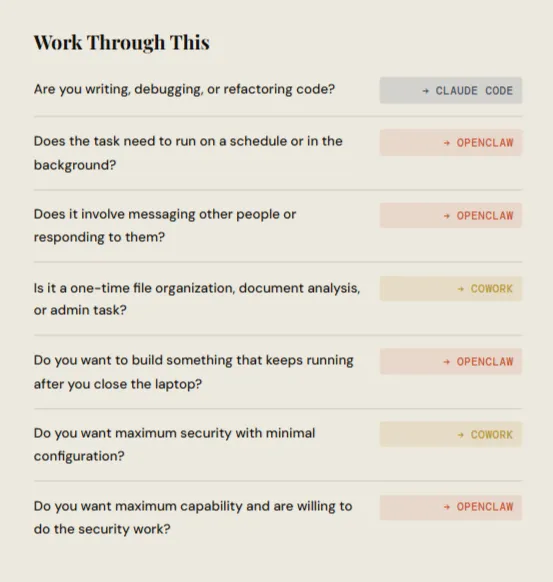
Which Tool Do You Need?
The One-Sentence Version for Each
OpenClaw is for technically capable people who want an always-on digital presence working on their behalf across every channel they use and who understand what proper security configuration requires.
Claude Code is for professional software engineers who want to move faster on real projects within the development workflows they already have.
Claude Cowork is for knowledge workers who want to automate document-heavy tasks without touching a command line, installing a dependency, or reading a security guide.
Common Questions
What's the actual difference between OpenClaw, Claude Code, and Claude Cowork?
They share AI foundations but serve entirely different roles. OpenClaw is persistent infrastructure — a 24/7 agent managing your calendar, email, and messages through your existing chat apps. Claude Code is a session-based expert for software development that understands entire codebases. Claude Cowork is a session-based agent for knowledge workers who need to automate document-heavy tasks without any technical setup.
Can OpenClaw replace Claude Code for coding tasks?
No, and it's worth being specific about why. OpenClaw can trigger Claude Code loops and run code-related actions remotely, but it doesn't have the deep codebase understanding, file manipulation precision, and architectural awareness that make Claude Code effective for real software development. They're meant to complement each other, not substitute for each other.
Do I need separate subscriptions for OpenClaw and Claude tools?
OpenClaw is model-agnostic and can use any provider, if you have a Claude Pro or Max subscription, OpenClaw can reuse those credentials via OAuth. Claude Code and Claude Cowork require Anthropic subscriptions directly, but they're covered by the same plan. So you could run all three for a single Anthropic subscription plus OpenClaw's additional API usage costs.